
An additional €400,000 in liquidity that doesn't actually exist

A medium-sized engineering firm is in the midst of a restructuring programme. Liquidity will determine how much time remains for the next steps. The latest forecasts show that the company has around 400,000 euros more breathing space, which gives it a few extra weeks to respond. This is welcome news in the current situation. However, the problem is that this additional buffer only exists on paper, whilst chaos is running rampant.
Claim overview:
Incident: €400,000 more liquidity changes the company’s plans
Consequences: A few weeks later, the forecast falls apart
Incident: €400,000 more liquidity changes the company’s plans
The engineering firm is seeking the support of an external consultant to assist with its liquidity planning. The aim is to reduce costs while ensuring there is sufficient liquidity to safeguard day-to-day operations. The consultant will collate the financial data and determine how long the financial headroom will last.
To this end, income, expenditure, outstanding liabilities and expected cash flows will be fed into a single model. The aim is to arrive at a figure on the basis of which management can plan its next steps.
The initial result provides some relief.
The model shows around €400,000 more in available liquidity than was initially assumed. The company therefore expects the financial buffer to last a few weeks longer. Based on this, management is postponing parts of a cost-cutting programme that had already been prepared and is refraining from securing additional financing for the time being.
Consequences: A few weeks later, the forecast falls apart
At first, nothing stands out. The figures seem plausible and fit with the scale of the rest of the planning. However, it is only a few weeks later that the discrepancies between the actual cash flow trends and the forecast become apparent. The supposed buffer is dwindling much faster than anticipated.
The company reviews the plans again and questions the consultant’s work.
By this stage, the postponed decisions cannot simply be made up for. Measures must be implemented at short notice, financing must be organised more quickly, and the company incurs additional costs.
The client holds the consultant responsible for this.
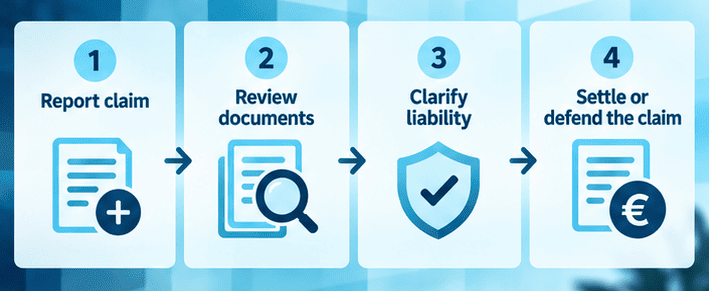
The incorrect forecast is a matter for Professional Indemnity Insurance.
It is alleged that, had the liquidity planning been accurate, management would have reacted sooner.
Ultimately, the company claims around €95,000 in damages. This includes additional costs, which the company claims arose from the delayed measures and the financing that became necessary at short notice.
The consultant reports the claim to exali under his Professional Indemnity Insurance. The case is then forwarded to the insurer for assessment.
The first step is to establish how the discrepancy of around €400,000 could have occurred. Was it actually due to an error on the part of the consultant?
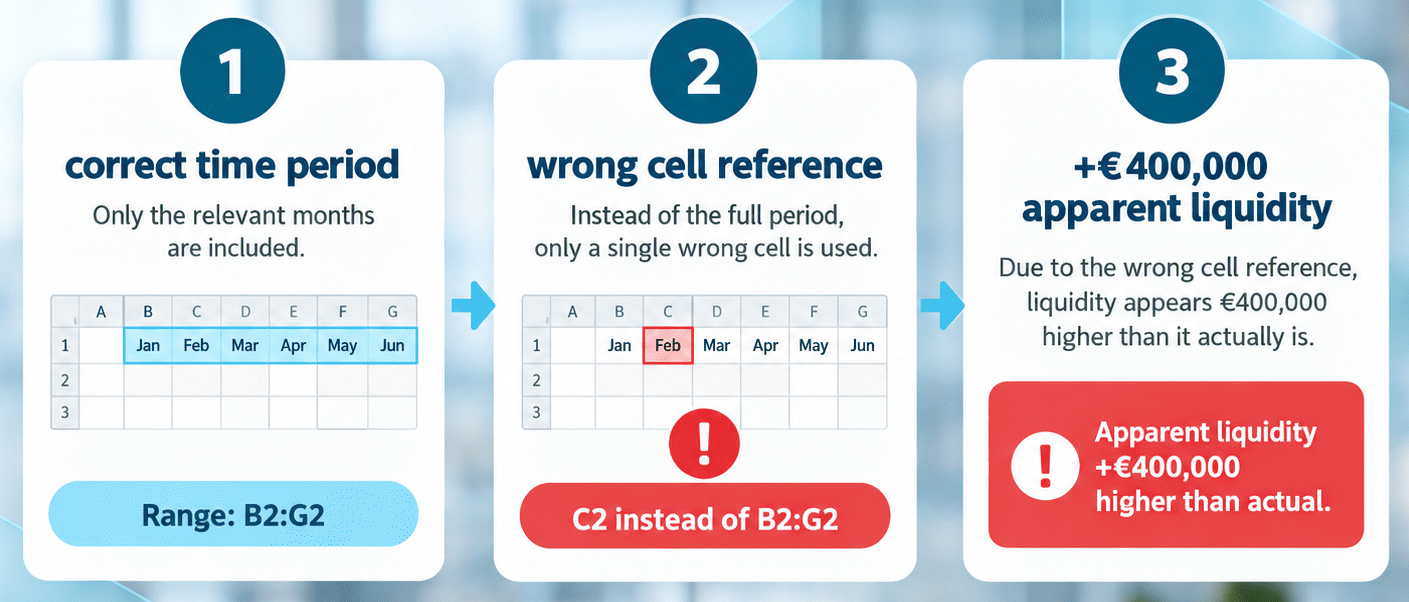
Cause: One wrong cell reference changed the calculation
So, liquidity planning is under scrutiny once again. After all, the cause is not a complicated financial assumption, but a single cell reference.
When a formula is copied, it accesses the incorrect time period. The result is mathematically correct. However, the underlying data is simply incorrect at this point. What makes this particularly challenging is that the error does not produce an obviously incorrect value. The additional liquidity of around €400,000 appears entirely plausible within the overall model.
This is precisely why the incorrect reference remains undetected for several weeks.
Claim: The consultant faces a €95,000 compensation claim
This answers the crucial question and paves the way for the claim to be settled. The insurer will cover justified compensation claims under the Professional Indemnity policy. Above all, one thing is clear for the consultant: not every instance of poor advice begins with a flawed strategy. Sometimes, a single error in a spreadsheet cell is enough.
The mistake was costly not only because of the incorrect figure, but also because of the decisions the company based on it. This is precisely what makes flawed analyses in consultancy so risky.



Vivien Gebhardt is an online editor at exali. She creates content on topics that are of interest to self-employed people, freelancers and entrepreneurs. Her specialties are risks in e-commerce, legal topics and claims that have happened to exali insured freelancers.
She has been a freelance copywriter herself since 2021 and therefore knows from experience what the target group is concerned about.